Why your body sounds the alarm, what’s really behind panic – and how to steady yourself in the first few minutes.
A panic attack is a false alarm in the nervous system:
Your body suddenly activates an ancient survival program, even though there is no real danger. Within just a few moments, your internal alarm systems switch into maximum tension. Heartbeat, breathing, muscles, sensory perception – everything shifts toward “survival.” In that moment, your system does not distinguish between something truly threatening happening and your brain simply interpreting a situation that way.
That is exactly why panic attacks can feel so life-threatening: Many people are convinced they are having a heart attack, about to faint or “about to go crazy.” From a clinical point of view, panic attacks belong to the anxiety disorders. They are extremely unpleasant, but in physically healthy people, they are not dangerous.
What matters is this: A panic attack does not mean you are weak, broken or “defective.” Your nervous system is trying to protect you – just at the wrong time.
Many people feel unsure whether what they are experiencing is “really” a panic attack. The following signs often appear in combination and build up intensely within a short period of time:
These symptoms are expressions of the same biological reaction: Within seconds, your stress system releases stress hormones such as adrenaline, and the body provides energy for fight or flight. What used to make sense when we had to flee from wild animals can feel completely out of place today in a meeting, at the supermarket or in the car – but physiologically, it is the same mechanism.
The question “Why do I have panic attacks?” can rarely be answered with one single cause. Most of the time, several factors come together:
When you have been under stress for a longer period of time – because of work, family, illness, lack of sleep or inner overwhelm – your nervous system can lose its balance. The sympathetic branch, the “gas pedal,” then remains more active than the calming parasympathetic branch. Your system reacts faster and more sensitively to stimuli: a brief moment of dizziness, a skipped heartbeat or a tense situation can be enough to set off the alarm.
What matters is not only what your body feels, but above all how you interpret it. Typical thoughts shortly before or during an attack might be:
These thoughts act like fuel on the fire: The fear of the symptoms intensifies the symptoms – a vicious cycle that turns the panic up even further.
Anyone who has experienced a panic attack usually wants one thing above all else: never to end up in a situation like that again. That is completely understandable – but there is a catch. If you avoid certain places, such as supermarkets, streets or trains, or certain activities, such as driving, exercising or traveling, your brain learns: “I would not be safe there. It’s good that I stay away.”
So-called safety behaviors can also keep anxiety going in the long term — for example, only going out with someone else, constantly checking your pulse or carrying certain “lucky charms” with you. Your system never gets to experience: “I can get through this even without these strategies.”
Physical factors can also make panic attacks more likely, for example:
Important: If you feel unsure, have a medical professional check whether everything is physically okay. If no organic cause is found, the focus shifts to the psychological level and the nervous system.
One image that helps many people is the so-called smoke alarm effect.
Imagine you have a smoke detector in your home with a small technical fault. It is overly sensitive and does not only sound the alarm when there is an actual fire, but already when you make toast or steam comes from the shower.
Your internal alarm works in a similar way: Your nervous system reacts as if a fire has broken out, even though objectively, there is no fire. Every impulse to flee – for example, jumping off the bus, leaving the shopping center or canceling an appointment – confirms to your system: “Good thing I sounded the alarm. It really was dangerous.” Next time, an even smaller trigger may be enough for the alarm to go off.
That is why the way out of panic is not constant running away, but new, corrective experiences: You stay in the situation – well prepared and with tools – and little by little, your body learns: “It was uncomfortable, but I was not in real danger.”
Subjectively, a panic attack often feels endless. Objectively, it looks different: The intense physical peak usually lasts 10 to 20 minutes.
During this time, the body releases adrenaline and other stress hormones. Heart rate and muscle tension increase, and breathing and perception change.
After that, the body automatically begins to lower the level of arousal again. You may still feel exhausted, shaky or “off” for longer afterward — this is the after-effect.
The important thing is: The attack cannot intensify endlessly, and it does not stay at that level of intensity all day, even though it may feel that way in the moment.
In an acute moment, what you want most is to get through the peak. The following strategies are not a replacement for therapy, but they can help you support your nervous system in the moment of panic.
Choose two or three that feel right for you and practice them outside of acute attacks as well.
Gently breathe in through your nose for four seconds and slowly breathe out through your mouth for six seconds. The longer exhale activates the calming part of your nervous system and acts like an inner “brake.”
Instead of letting the inner catastrophe movie keep playing, you can say sentences to yourself such as:
This takes away some of panic’s power. You do not have to be fully convinced that every sentence is 100 percent true – it is enough to use it like an anchor.
A short stimulus from your surroundings can help your nervous system reorient itself. For example, hold your wrists under cold water, place a cool cloth on the back of your neck or take a sip of cold water and focus on the temperature. The cold stimulus has a regulating effect and can help pull you out of the inner spiral.
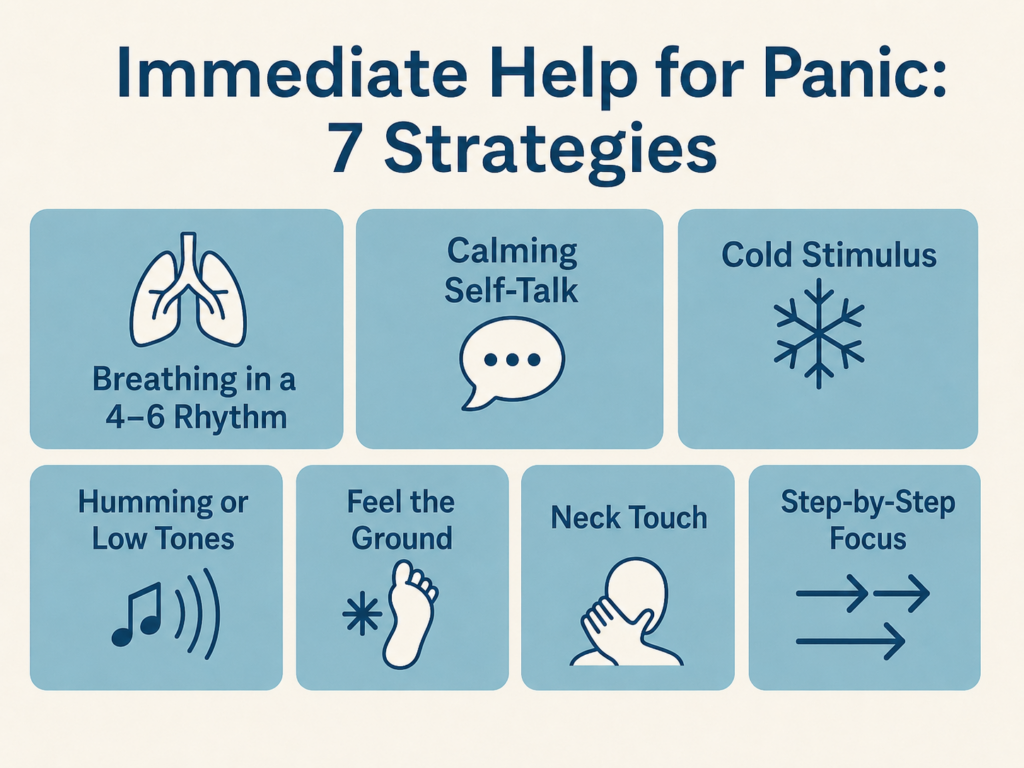
Through humming, singing or making low sounds, you create subtle vibrations that stimulate the vagus nerve. You can quietly hum to yourself or make a long “mmmmh” sound. It sounds simple, but it can have a surprisingly calming effect.
Place both feet firmly on the ground and bring your attention very intentionally to the contact: How do the soles of your feet feel? Can you feel pressure, warmth or the texture of the surface beneath you? This form of grounding helps anchor you more in the here and now again.
Place one or both hands on the back of your neck or your shoulder area. You can apply gentle pressure or make small circular movements. Physical touch can give the nervous system a sense of safety – similar to a calming hand on your shoulder.
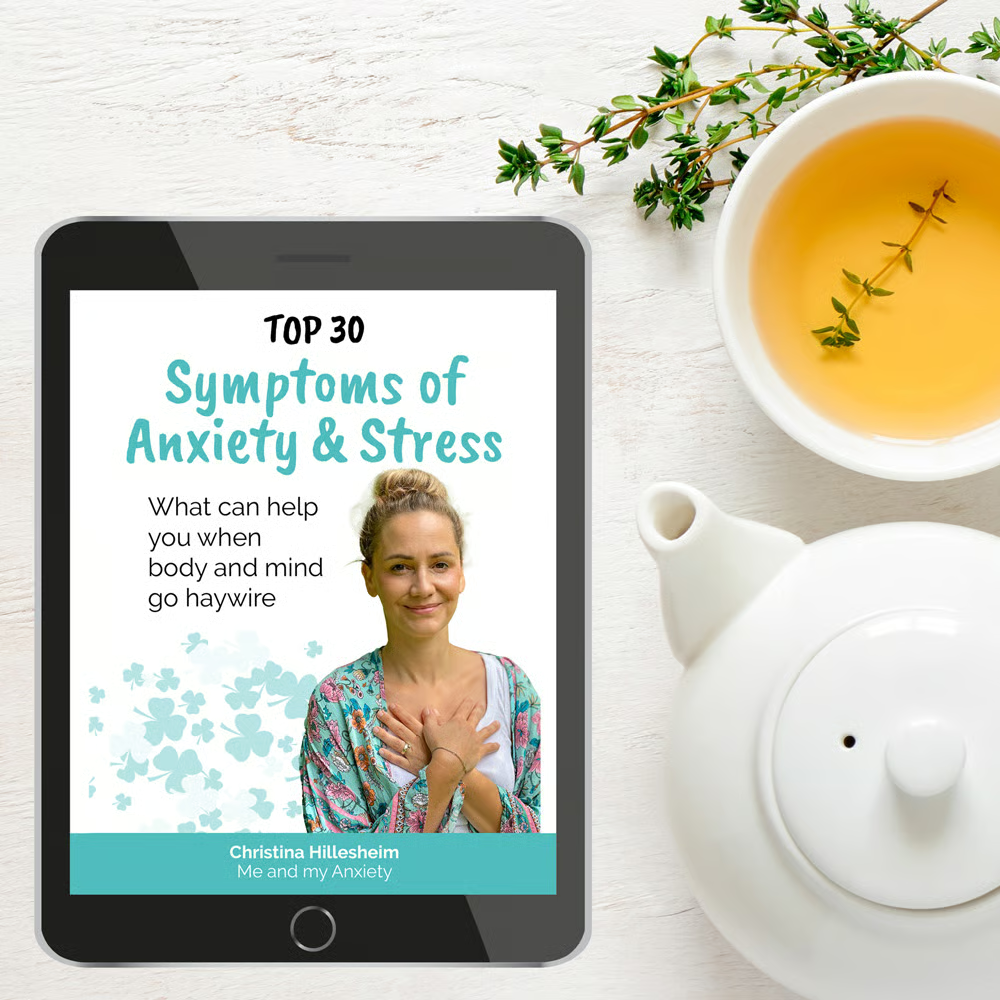
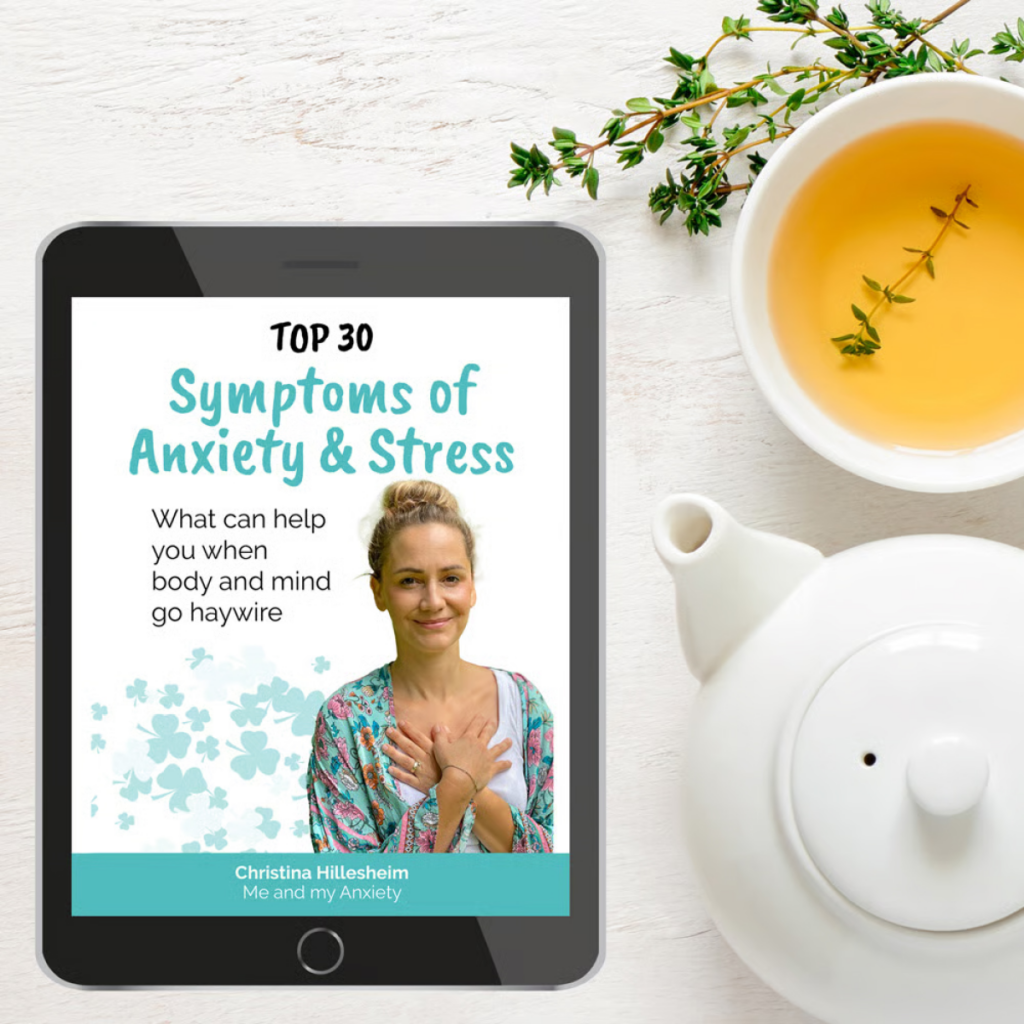
Racing heart, dizziness, nausea, chest pressure … Does your body sometimes feel like it’s going haywire – and you find yourself wondering if it really is “just” anxiety?
Then this e-book is exactly what you need:
👉 TOP 30 Symptoms of Anxiety & Stress
Inside, I reveal the 30 most common physical symptoms associated with anxiety and stress, explain them in easy-to-understand terms, and offer gentle, immediately actionable tips on how to soothe them, step by step.
When you are moving – for example, going outside or walking back and forth in the room – connect each step with a short sentence, such as: “One step, one breath.” This gives the moment structure instead of focusing only on the anxiety.
Breathing is a bridge between conscious control and unconscious body processes. Usually, it happens automatically and adapts to your current situation. But when you consciously breathe more calmly and deeply, you send your system the message: “It is safe enough to come back down.”
Especially during panic attacks, many people tend to breathe shallowly or very quickly – and sometimes they unconsciously hold their breath. This can intensify dizziness, tingling and feelings of tightness.
Breathing techniques help you interrupt this cycle and regain a little more influence over your body. They are not a magic cure, but they are a very effective tool for everyday life.
Immediate help is important – but it is even more valuable to support your nervous system in the long term so that panic attacks become less frequent and less intense. Some building blocks for this are:
Every small step toward understanding and self-care is valuable. So you can feel more safety and more freedom to take action in your own life again.

About the Author: Christina is a qualified sociologist, bestselling author from germany. She knows from personal experience what it is like to suffer from anxiety, panic and exhaustion.
After a burnout and years with depression and anxiety disorder, she fundamentally changed her life.
In her Online Courses, her E-Books and podcasts, Christina shows how psychosomatic complaints develop, how your nervous system communicates with you — and how you can manage to ease such physical symptoms.
Fainting during panic attacks is very unlikely. Your body is in activation mode: blood pressure and heart rate increase to make you more capable of responding. Fainting is more likely to happen when blood pressure suddenly drops, for example with certain forms of blood or needle phobia.
A panic attack can feel dramatic and threatening – but that does not mean it is life-threatening. If you have had your heart and circulation checked medically and everything is healthy, panic attacks themselves are not dangerous. They are a sign that your stress and alarm system needs support.
It often feels as if panic comes without a trigger. But in many cases, there have already been underlying stressors in the background for a while: too little sleep, unresolved conflicts, overwhelm, physical exhaustion or ongoing tension. The attack is then more like the visible peak of a longer process.
Yes. Many people report panic that wakes them from sleep. Here too, a sensitive nervous system plays a role. At night, the body processes experiences and tension – and sometimes this shows up as nighttime panic. Long-term nervous system care and a calm evening rhythm can be supportive.
Many people experience a significant improvement over time: the attacks become less frequent, less intense or may even disappear completely for a while.
What matters is understanding the mechanisms behind them and developing new strategies for dealing with anxiety. Support can be very helpful with this.
Would you like to learn more about your psychosomatic symptoms and find out what can help you alleviate them? Then feel free to check out this e-book: