“You need to regulate your nervous system – and everything will get better!”
Have you already received one or two tips along those lines and don’t really know what that actually means?
Then this article will definitely help you … because you could say I’m a professional through personal experience.
For many years, my nervous system was completely overstimulated. My intense anxiety and constant inner stress meant that I was basically always on high alert, always tense. As if a saber-toothed tiger could jump on me at any moment and I had to be ready to flee or fight. Every irregularity threw me off balance and overwhelmed me. Real inner relaxation was out of the question.
Does that sound familiar?
Then in this article, I’d like to show you why it is so important to be able to regulate your nervous system and which specific tips can help you calm your nervous system.
In short: regulating your nervous system is so important because it allows us to recover from the many everyday stressful situations and prevents us from ending up in a constant state of overwhelm — all the way to burnout.
You can imagine it like this:
Our autonomic nervous system is made up of the sympathetic nervous system and the parasympathetic nervous system.
The sympathetic nervous system is the part that puts us on high alert in stressful situations. For example, it ensures that:
We are then in fight-or-flight mode, tense and full of energy.
The parasympathetic nervous system, on the other hand, is the natural counterpart. It ensures that we release energy and tension again and return to a state of rest.
When we regulate our nervous system, the sympathetic and parasympathetic nervous systems work like the brake and accelerator in a car:
The sympathetic nervous system is like the accelerator pedal that activates the body and gets it running at full speed when necessary.
The parasympathetic nervous system, on the other hand, is like the brake that calms and slows the body down when rest and recovery are needed.
Both need to work together perfectly in order to steer the car safely and efficiently — or, in this case, to keep the body in balance.
When the nervous system is dysregulated, the interaction between the sympathetic and parasympathetic nervous systems no longer works properly.
This means that the body no longer truly calms down after a stress response and the nervous system remains overactivated.
So you feel constantly tense and stressed and are unable to truly recover.
With chronic stress, the nervous system no longer releases “only” adrenaline, but also cortisol — and over time, this can make us physically ill and, in the long term, also lead to sleep problems, depression, anxiety and numerous other physical symptoms of anxiety and stress.
I experienced all of this myself — all the way to my burnout in 2016.
Are you wondering how you can tell whether your nervous system is dysregulated?
The following checklist gives you 20 typical signs of a dysregulated nervous system:
To be able to regulate your nervous system, one thing is especially important:
You need to reduce stress and very deliberately show your nervous system:
There is no danger. You are allowed to relax now.
Breathing exercises can help you in acute stressful situations, just as body-based exercises can help by stimulating your vagus nerve – and therefore your parasympathetic nervous system.
In the long run, however, it is especially helpful to bring relaxation-promoting habits into your life and adjust your life in such a way that you do more of the things that give you strength and make you happy.
Below, I’ll introduce you to 20 specific tips for regulating your nervous system.
Sit down comfortably and breathe deeply through your nose into your belly. Then hold your breath briefly and exhale very slowly through your mouth.
Ideally, the exhale should take twice as long as the inhale.
This exercise activates the parasympathetic nervous system and calms the nervous system.
The vagus nerve runs from the brainstem in the head, along the neck and down into the abdomen.
It is also known as the “rest nerve” because it belongs to the parasympathetic nervous system and allows you to have a direct positive influence on your nervous system.
Exciting exercise: To stimulate the vagus nerve, for example, you can yawn strongly. Open your mouth very wide and try to pronounce an “R” without closing your mouth any further. Do this 4 times.
This should make you yawn deeply and activate your parasympathetic nervous system.
Spend as much time as possible in green surroundings – ideally directly in the forest!
Studies show that forest bathing has a positive effect on our stress levels and that walks in the forest can demonstrably reduce the concentration of the stress hormone cortisol.
Mindfulness exercises can help you reduce stress and regulate your nervous system.
To do this, focus on the present moment by consciously perceiving your surroundings. Personally, I like to combine this with a walk. Why not try it, too?
Activate all your senses during your walk and consciously pay attention to sounds, smells, visual impressions and sensations.
Use essential oils such as lavender or chamomile to calm yourself and relax your nervous system.
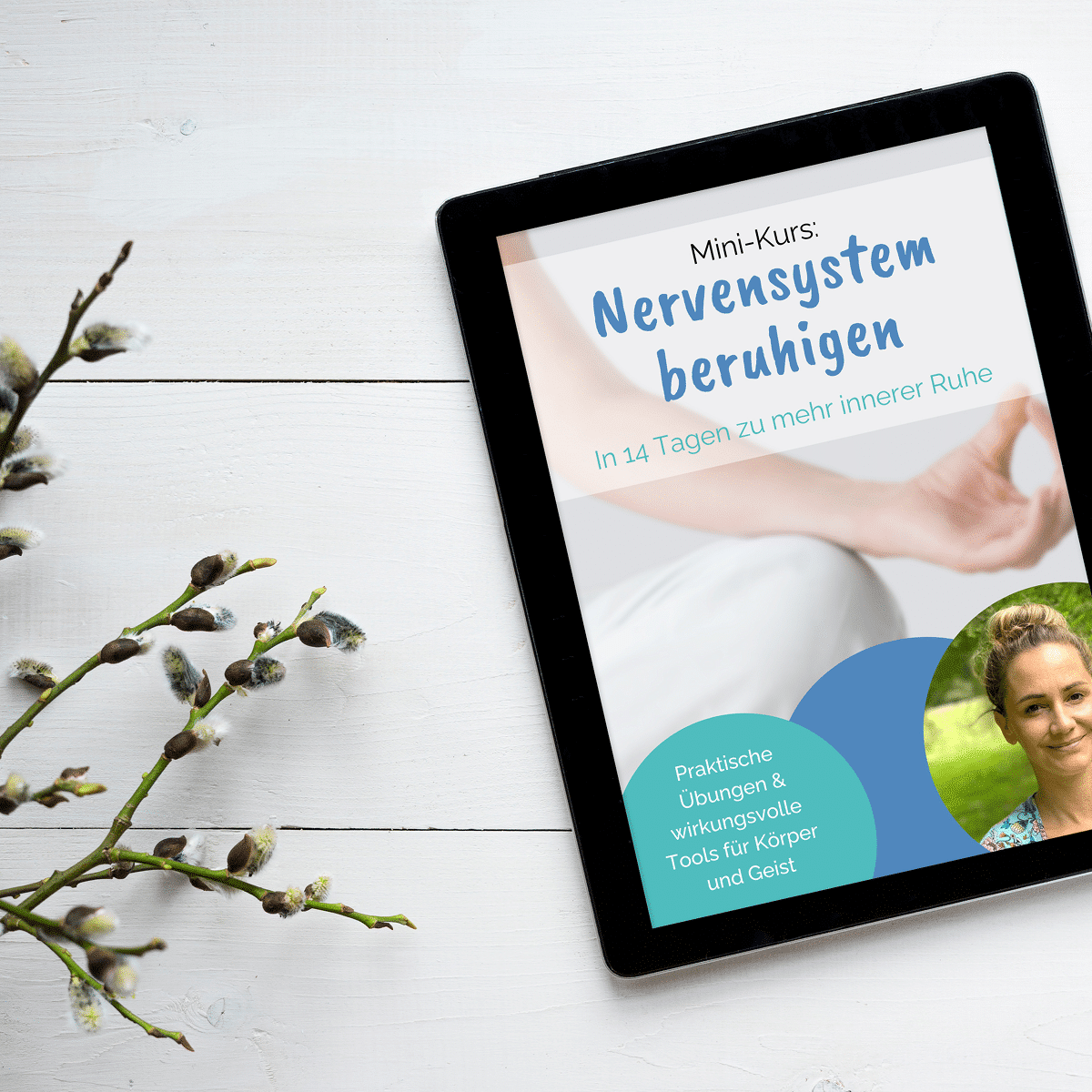
I have developed a mini course in which I send you one email every day for 14 days with an exercise that can help you calm your nervous system.
Directly applicable, with simple video instructions and an accompanying workbook.
 Go to the Mini Course “Regulate Your Nervous System”
This course is not just another collection of relaxation tips.
It is a concrete, loving guide to help you move out of constant tension – without pressure, but with real understanding.
Humming activates the vagus nerve, which has a calming effect on the nervous system. It also helps slow down your breathing and relax you.
Ommmmmm!
One of my favorite exercises: Hold your hand in such a way that your thumb can find the deepest point in the palm of your hand. Then massage this point with circular movements.
This so-called “emergency point” has often helped me calm down during stress and anxiety.
Travel in your mind to a place you associate with relaxation and peace, and recharge yourself there with inner calm and energy.
Guided imagery can also help you reduce stress and calm the nervous system.
A short walk or gentle stretching can help you release tension and calm your nervous system.
My personal recommendation: Dance to your favorite music. It’s wonderful for reducing stress and almost guaranteed to put a smile on your face.
Meditation is not always easy for many of us – but it is still incredibly effective against inner restlessness:
Sit in a comfortable position and focus on your breath. Try to simply let your thoughts pass by and stay in the moment.
Especially in acute anxiety situations, a calming meditation for anxiety can help you calm down.
Perhaps the most important tip for reducing stress and becoming more balanced: Bring many of the things into your life that make you happy and give you energy, and learn to say no to the things that are not good for you.
A healthy diet supports the function of the nervous system and contributes to balanced hormones.
Your mineral stores of magnesium, calcium and potassium should always be well filled.
Drink at least 1.5 to 2 liters of water or unsweetened tea every day – caffeine and alcohol, on the other hand, are better removed from your diet.
If you would like to learn more about the effects of nutrition on stress, I can recommend this video workshop:
Nutrition for Anxiety & Stress.
Regularly practice yoga, meditation, autogenic training or other techniques and exercises that help you relax and reduce your stress.
These relaxation methods also help you become more resilient to stress in the long term.
Regulate your nervous system through more me-time:
Consciously make time for yourself and your self-care.
In this way, you strengthen your well-being and therefore also the resilience of your nervous system.
Free your mind from all those many thoughts, worries and to-dos!
Whether you simply leave notes everywhere, write creative texts or keep a diary: Journaling is a wonderful method for reducing stress and finding inner peace.
Integrate regular physical activity into your daily life.
If you are not a sports person, perhaps consider using the car or train less in the future and walking or cycling instead.
Movement and exercise promote the release of endorphins and help you strengthen your nervous system in the long term.
Spend as much time as possible with people who are good for you.
Spending time with your loved ones makes you happy, helps reduce stress and strengthens your resilience.
Good sleep is essential for being able to regulate the nervous system and allowing the body to regenerate properly.
Make sure you get enough regular sleep. Try to go to bed and get up at approximately the same time every day.
Tip for falling asleep more easily: Avoid screens for at least 30 minutes before going to bed.
Affirmations are messages you say to yourself in order to positively influence your thoughts and feelings.
In this way, you can support yourself in allowing yourself to take breaks, taking better care of yourself or motivating yourself.
Here you can find my selection of affirmations for more self-love.
Plan your time effectively, schedule enough rest periods, set priorities and learn to delegate to-dos.
Good time management can help reduce stress.
But it is important to understand:
Anything that is good for you can help you.
Because whenever you are in your element, when you take good care of yourself and do things that you enjoy, you strengthen your stress resilience.
This allows you to cope better and better with everyday life, increase your well-being and bring inner peace into your mind.
Especially people with anxiety usually have a nervous system that has completely gotten out of control.
They are constantly on edge, permanently tense and find it very difficult to switch off and find calm.
And as a result of this dysregulated nervous system, those affected then feel even more stress, even more anxiety, even more tension — including all the distressing physical symptoms that stress and anxiety bring with them.
That’s why one thing is especially important if you want to let go of your anxiety in the long term:
That you learn how to regulate your nervous system and find your way back into relaxation.

About the Author: Christina is a qualified sociologist, bestselling author from germany. She knows from personal experience what it is like to suffer from anxiety, panic and exhaustion.
After a burnout and years with depression and anxiety disorder, she fundamentally changed her life.
In her Online Courses, her E-Books and podcasts, Christina shows how psychosomatic complaints develop, how your nervous system communicates with you — and how you can manage to ease such physical symptoms.
Regulating the nervous system means bringing the body out of a state of stress or overarousal and back into calm and safety.
The goal is to restore the balance between tension and relaxation so that the body, thoughts and emotions can stabilize again.
Effective exercises for regulating the nervous system include breathing techniques, mindful body exercises, gentle stretching, meditation or consciously perceiving your surroundings.
Rhythmic movements such as walking or rocking can also help calm the stress system and build inner stability.
A dysregulated nervous system often shows itself through symptoms such as inner restlessness, sleep problems, irritability, exhaustion or ongoing tension.
Difficulty concentrating or strong physical stress reactions can also be signs that the body is constantly operating in alarm mode.
When stress has been ongoing, it can take several weeks or even months for a dysregulated nervous system to stabilize again.
Sustainable lifestyle changes can support this process, such as sufficient sleep, a balanced diet, regular movement and conscious stress reduction in everyday life.
If you want to deepen this knowledge and, above all, start putting it into practice, take a look at my mini course on this topic:
Go to the Mini Course “Regulate Your Nervous System”
In it, I take you by the hand and introduce you to simple but effective exercises over 14 days that you can implement immediately to bring calm into your body and mind and let go of stress.